
What is CVA?
Definition of Cash and Voucher Assistance
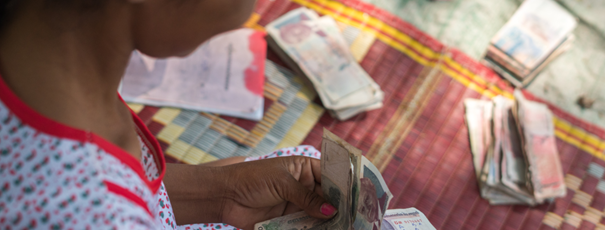
Cash and Voucher Assistance (CVA) refers to the direct provision of cash transfers and/or vouchers for goods or services to individuals, households, or group/community recipients. In the context of humanitarian response, CVA excludes payments to governments or other state actors, remittances, service provider stipends, microfinance and other forms of savings and loans (CALP Network: Glossary of Terminology for Cash and Voucher Assistance, 2023).
Cash and vouchers are transfer modalities which can be provided separately or in combination with other modalities, such as in-kind aid, service delivery, or technical support.
Opportunities and Risks
In a world where needs are on the rise, while resources are dwindling, and where humanitarians strive for effective assistance with increased accountability, CVA emerges as a tool to enhance the effectiveness and efficiency of humanitarian responses.
CVA empowers crisis-affected people by enabling them to identify and address their most pressing needs. It provides flexibility to buy essential goods and access services according to personal preferences, reducing reliance on negative copings mechanisms. CVA also stimulates local economies, promotes financial inclusion, and offers economies of scale for donors. When it comes to risks, these are often rooted in subjective perceptions rather than evidence. In fact, evidence contradicts the notion that CVA is inherently more prone to risks than other types of assistance, showcasing the success of well-programmed CVA even in challenging contexts.
Read the blog post on cash and risks: Cash is no Riskier than Other Forms of Aid. So Why Do We Still Treat In-kind like the Safer Option? by Stefan Bumbacher
Background
CVA gained prominence in 2004 through cash transfer pilots in response to the tsunami in South and South East Asia. Since then, the use of CVA has steadily increased, with significant improvements in quality. Emphasising the preference for CVA, the Secretary General stated at the World Humanitarian Summit in 2016 that «where cash is considered feasible, it should be the preferred and default modality». In 2022, CVA comprised 21% of global humanitarian assistance. However, according to a study by the CALP Network, CVA could potentially account for 30-50% if it was implemented wherever feasible and appropriate (CALP Network: Increasing the Use of Humanitarian Cash and Voucher Assistance: Opportunities, Barriers and Dilemmas, 2022).